

The Golden Rule: Defining AI's Role in Your Studies
When figuring out how to use AI for homework, successful students draw a hard line between active assistance and passive automation. The goal is to enhance your understanding, not to outsource your brain.
✅ The Right Way (Do This)
Treat the AI as a strict tutor or a study partner. Command it to explain complex concepts in simple terms, critique your thesis statement for logical holes, or quiz you on vocabulary before an exam. Use it to brainstorm fresh topic ideas or summarize dense reading materials to ensure you grasped the main points.
❌ The Wrong Way (Don't Do This)
Never copy and paste generated text directly into your document as your own work. Do not ask it to write full essays or solve math problems without explaining the underlying logic. Using AI to bypass the actual thinking process is not studying. It is academic dishonesty.
Master the Workflow: 5 Actionable Steps
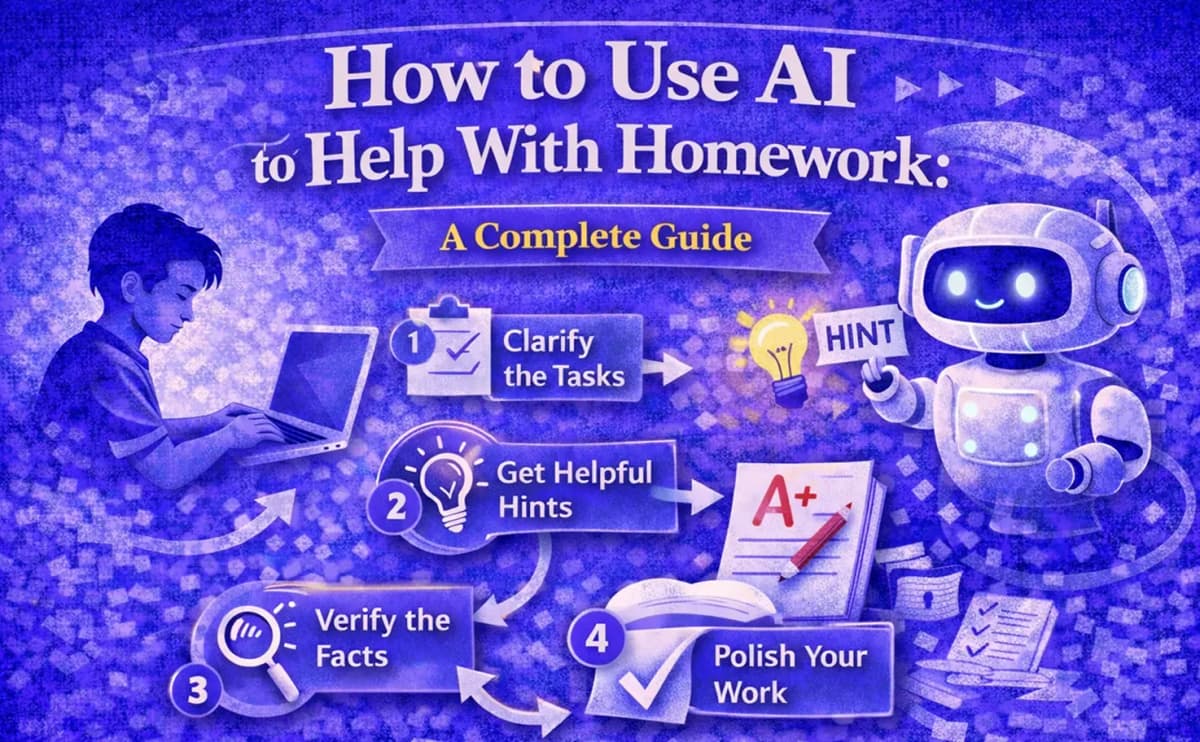
To truly benefit from these tools, you need a structured approach. Learning how to use AI to help with homework effectively comes down to following a disciplined, five-step workflow that prioritizes your own input over the algorithm's output.
Step 1: Analyze the Requirements
Before opening any chatbot, dissect your assignment sheet to understand exactly what is required. You must isolate specific constraints like the required word count, citation style, and grading rubric to ensure you don't miss the basics.
- Specific Word Count Range
- Formatting Style (APA, MLA, etc.)
- Number of Sources Needed
- Key Grading Criteria & Deadline
Step 2: Attempt the First 10%
Never start with a blank cursor. Force yourself to produce the first piece of content manually to establish your own direction. This "10%" rule prevents the AI from dictating the structure and ensures the core ideas remain yours.
What "10%" looks like: Writing a rough thesis statement, bulleting a 5-point outline, or solving the first equation alone.
Step 3: Request Socratic Hints
Instead of demanding the final answer, ask the AI to guide you through the problem-solving process using hints. This method mimics a real teacher, forcing you to engage with the material rather than passively receiving it.
Prompt: "I am stuck on this concept. Do not give me the answer. Instead, give me a hint and ask me a guiding question to help me solve it myself."
Step 4: Verify Every Fact
AI tools frequently "hallucinate," inventing citations, dates, and definitions that look real but are completely fake. You must treat every AI output as a draft that requires rigorous fact-checking against trusted sources.
- Specific Dates and Names
- Direct Quotes and Citations
- Mathematical Formulas
- Scientific Definitions
Prompt: "List every specific fact, date, and definition in this response that I should cross-reference with my textbook."
Step 5: Polish Your Voice
Write your draft yourself, then look at how to use AI for homework help to refine your mechanics. The goal is to smooth out awkward phrasing and fix grammar errors without stripping away your personal writing style.
Prompt: "Review this paragraph for clarity and flow. Do not rewrite the whole thing. Just point out awkward sentences and suggest minor edits to improve readability."
High-Impact Prompts: The Copy-Paste Library
Knowing how to use AI for homework isn't about asking magic questions. It is about providing specific context. The difference between a generic answer and a useful study aid is the "Role-Task-Constraint" framework. Use these templates to control the output.
The Master "Role-Task" Formula
Use this structure for any subject to ensure the AI understands your specific needs.
How to use: Define a persona, state the specific job, and set limits.
Template: "Act as a [Subject] expert. Your task is to [Action]. Do not [Constraint]."
The "Strict Tutor" Protocol
Best for understanding difficult concepts without cheating.
How to use: Forces the AI to guide you rather than solving it for you.
Template: "Act as a strict tutor. I am trying to solve [Problem]. Do not give me the answer. Instead, ask me a guiding question to help me figure out the first step."
The "Logic Check" Request
Best for refining essays or checking math logic before submission.
How to use: Paste your draft or solution to identify errors.
Template: "Review my logic in this [Paragraph/Equation]. Point out any fallacies or calculation errors, but do not rewrite it for me."
The "Active Recall" Generator
Best for exam preparation and active recall.
How to use: Paste raw class notes to generate study materials.
Template: "Here are my notes on [Topic]. Create a 5-question multiple-choice quiz based on these facts. Put the answer key at the very bottom."
Subject-Specific Strategies
Different subjects require different strategies. Below is a breakdown of how to use AI to help with homework across various disciplines.
Writing & Research Papers
Overview: Use AI to brainstorm thesis statements or outline arguments, not to generate the text itself.
Prompt: "Provide 3 counter-arguments to the claim that [Your Thesis]. I need to strengthen my rebuttal section."
STEM: Math & Science
Overview: Focus on understanding the ""why"" behind the solution. This is how to use AI for homework help effectively in STEM.
Prompt: "Explain the step-by-step logic needed to solve this differential equation. Do not just show the final number."
Coding & Debugging
Overview: Perfect for debugging code or explaining complex syntax errors.
Prompt: "I am getting a syntax error on line 45. Explain what caused it and suggest a fix, but explain why the fix works."
Foreign Language Practice
Overview: A conversational partner that is available 24/7 for practice.
Prompt: "Act as a native French speaker. Have a conversation with me about my weekend at an A2 proficiency level. Correct my grammar after every response."
Slide Decks & Speeches
Overview: Ideal for structuring slide decks and condensing complex topics into bullets.
Prompt: "I have a 10-minute presentation on [Topic]. Suggest a 5-slide outline with main bullet points for each slide."
The Verification Checklist: Stopping Hallucinations
As we touched on in Step 4, AI models are famous for "hallucinating", inventing facts with total confidence. While Step 4 established the need to verify, this checklist breaks down exactly what to look for. To master how to use AI for homework help safely, treat every response as a claim that needs proof, not a fact.
Always cross-reference the following elements against your textbook:
- Facts/Dates: Verify all historical events and names.
- Formulas: Double-check math steps and chemical equations.
- Citations: Ensure quotes and sources actually exist.
- Definitions: Confirm technical terms match class context.
- Alignment: Accurate answers are useless if they miss the prompt's specific requirements.
The Reality of Academic Integrity and AI Detectors
Before you start learning how to use AI to do homework, you must read your syllabus. Policies vary wildly. Some professors encourage AI for brainstorming, while others view it as instant failure.
Do not trust AI detectors blindly. They are notoriously unreliable and frequently flag 100% human-written work as artificial. The only way to protect yourself is through an ethical workflow.
Keep a "paper trail" of your work: save your chat logs, version histories, and outline drafts. If you use AI only to critique or structure your original ideas rather than generating the final product, you can confidently defend your authorship if questioned.
Digital Hygiene: Protecting Your Private Data
When figuring out how to use AI to do homework, remember that "free" tools often pay for themselves with your data. Chat history is rarely private and can be reviewed by human trainers. Never paste the following into a chatbot:
- Passwords or login credentials.
- IDs like social security or driver's license numbers.
- Personal Data such as home addresses or phone numbers.
- Private Docs or unpublished research without explicit permission.
Top AI Study Assistants Compared
| Tool | Accuracy | Transparency | Free Plan |
|---|---|---|---|
| HomeworkAI | High | Shows steps & sources | Yes |
| NoteGPT | Medium | Summaries only | Yes |
| Edubrain | High | Explains logic | Limited Trial |
| Decopy AI | N/A (Detector) | Detailed Report | Yes |
| QuestionAI.io | High | Step-by-step | Yes |